
The composting plant
The composting plant of Moraro
45° 55' 2.299'' N, 13° 30' 1.455'' E
45.9178609496, 13.5004043916
The plant (which is currently undergoing revamping) can process up to 18,000 tons of waste annually, consisting of the organic fraction from separate collection and green waste from mowing and pruning arriving from all the municipalities of the former province of Gorizia and from the municipalities of Duino Aurisina, Sgonico – Zgonik, and Monrupino in the province of Trieste.
How it works
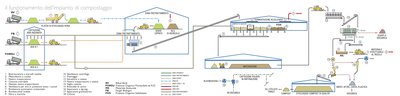
All organic waste that enters the composting plant is checked at the weighing station which, through a recognition badge provided to each vehicle that performs the collection, automatically records the load, the type of waste, and the municipality of origin.
While the incoming green waste is deposited on an external platform and shredded in anticipation of being mixed with the organic fraction, the latter is deposited in special containment tanks located within the reception area.
Once the mixing is completed (on average 60% wet and 40% green) and the blending, the mixture is automatically sent to the accelerated oxidation section.
This section consists of 7 lanes, each 60 m long and 3 m wide, bordered by perimeter walls. The material deposited in the lanes is moved by a turner that daily shifts it forward by 4 m with each pass. The action of the turner helps to promote the oxygenation of the mixture and the related composting process. In the area of accelerated oxidation, the wet/green mix remains for 21 days.
All the activity of the turner is managed through dedicated software that monitors the movements the machine makes while moving along the entire length of the aisles on a translation cart. Once the accelerated oxidation phase is completed, the material is deposited in the maturation area for a minimum period of 70 days and handled biweekly by a rubber turner operated from a pressurized cabin. It is here that the composting process of the material is completed, which, before being made available, undergoes a screening intervention necessary to intercept any non-compostable residues.
At the end of its process, the compost is deposited in a dedicated area awaiting its packaging or collection for use; considering the weight loss and water loss that characterize the composting process, a quantity of compost equivalent to 30% of the material that entered the plant is obtained from the mixture of green and wet waste.
All closed treatment rooms of the composting plant are maintained under slight negative pressure to facilitate the aspiration of air, which is then treated by the two biofilters that operate respectively for the maturation area and for the accelerated oxidation and delivery areas. The biofilters that deodorize the air drawn from the rooms are structures made of large concrete tanks nearly 3 meters deep, inside which a layer of shredded wood about 2 meters thick is deposited. The air drawn from the rooms through air ducts is directed to a fan that blows it at the base of the tank, from where it rises and passes through the biofilter bed, releasing the odoriferous molecules.
The produced compost is subjected to laboratory analysis that certifies its quality, and its certification is always issued to all users who take large quantities for agricultural use.
Compost is used particularly for viticulture but also more generally for the cultivation of all agricultural products.
During the various phases of composting, other waste also remains that is treated in accordance with the regulations governing the disposal of non-recyclable and reusable materials.
In particular, the leachates collected on the internal flooring, the liquid generated by the biofilters, and the water collected in the green management area are stored in an underground tank to be subsequently sent for disposal at treatment centers.